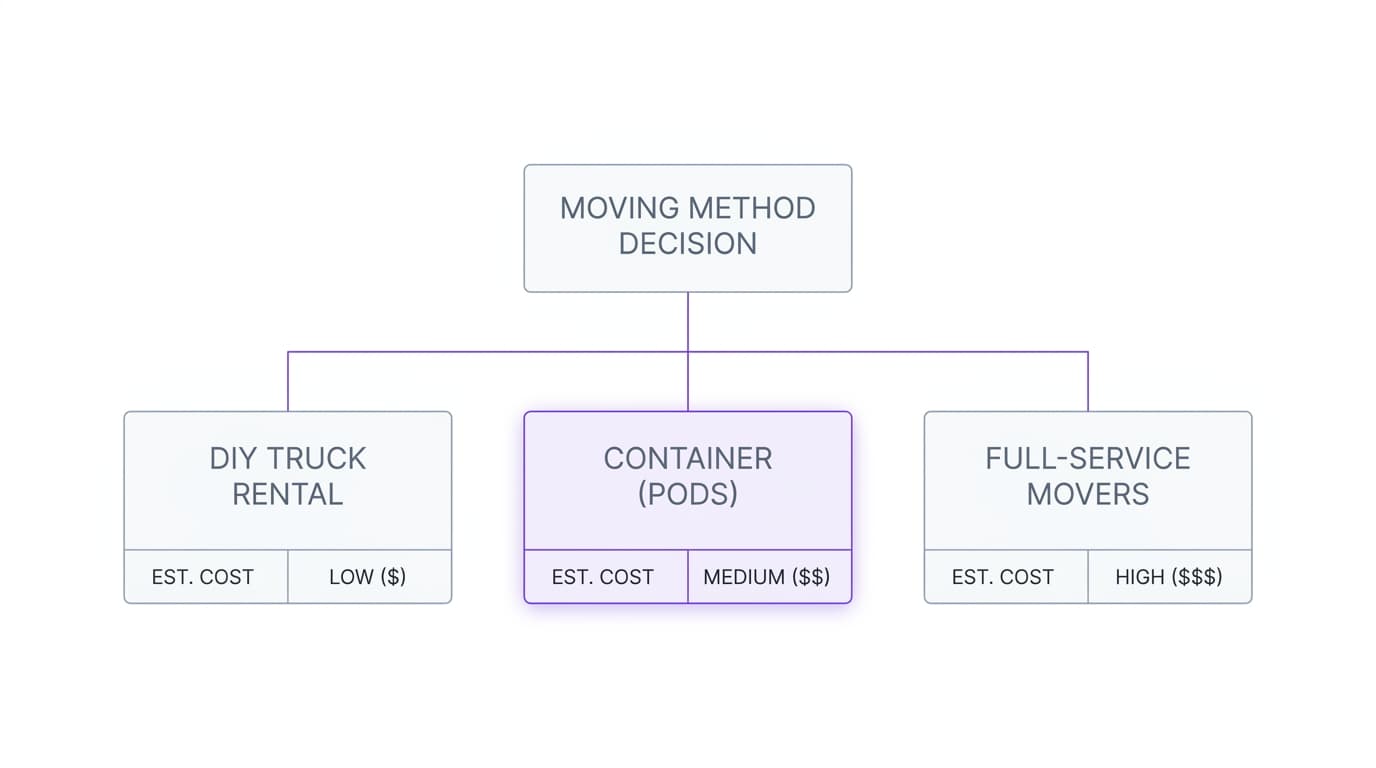
The cheapest path is almost always truck rental — if you have time, help, and the willingness to drive. The most-expensive path is full-service— and it's worth it when your time is genuinely valuable, you have specialty items, or you're moving cross-country with no friends or family on either end. PODs sit in the middle— they're the right answer for phased moves, storage-in-transit, and any situation where you want to load on your schedule but not drive a truck across the country.
| Option | Typical cost | Labor on you | Schedule control |
|---|---|---|---|
| Truck rental (DIY) | $1,200–$3,500 (cross-country, 2BR) | 100% — drive, load, unload | Total — leave when you want, arrive when you want |
| PODs / portable container | $2,500–$6,000 (cross-country, 2BR) | Pack + load yourself; PODs handles transport | Strong — you control the load + unload windows |
| Full-service movers | $5,000–$12,000 (cross-country, 2BR) | Optional packing; movers do everything else | Limited — mover sets the delivery window |
The decision tree
Q1: Is your move under 100 miles? Skip this guide. Hire a local moving company hourly. PODs and truck rental have setup overhead that doesn't pencil for short moves.
Q2: Do you have at least one full weekend of time, two friends willing to help, and a valid driver's license? If yes — strongly consider truck rental. You'll spend $1,200–$3,500 cross-country vs. $5,000–$12,000 full-service. That's $4,000–$8,000 in your pocket for ~3 days of work.
Q3: Do you need a delay between loading and unloading— house closing dates that don't line up, kid finishing the school year, job starting before housing is ready? PODs win. Storage in transit is built into the model; you can hold the container 30+ days at modest cost. A full-service mover will charge $1,000–$3,000 for the same thing.
Q4: Do you have specialty items? Piano, gun safe, $5K+ art, lab equipment, gym setup. These are full-service territory — DIY damage risk is high and the insurance economics favor a pro crew with the right equipment.
Q5: Are you cross-country with no help on the destination end? Full-service. Loading is half the work; unloading alone after a 3-day drive is brutal. The premium buys you a fresh crew that will unload in a few hours instead of you doing it across two days.
Q6: Is your time worth more than about $80 / hour to you? If yes — full-service almost always wins on opportunity cost. The 30–40 hours of personal labor a DIY move requires has a price; once it crosses your hourly rate, paying movers is the economically rational call.
PODs: the underrated middle
PODs (the brand) and competitors like 1-800-PACK-RAT and U-Pack are structurally different from both truck rental and full-service. They bring a portable container to your home, you load it on your schedule (typically 2–4 days), they pick it up and ship it, you unload at the destination on your schedule. No driving. No tight load-unload window. No paying for unused capacity.
The PODs model genuinely beats both alternatives in three specific situations: a) you need storage between moves (e.g., closing dates 2–6 weeks apart),b) you're moving from an apartment with parking constraints (the container can sit on the street while you load over multiple days), or c) you have help on the load end but not the unload end(your moving day is friends + beer; the unload is just you, and that's manageable when you can pace it over a week).
When full-service is genuinely worth it
We say this even though full-service movers are who we route leads to: most moves don't need full-service. The price premium is real (often 2-3x truck rental), and a lot of full-service moves could have been handled by a $1,500 truck and two friends.
That said, full-service genuinely wins in a few situations: cross-country with specialty items, time pressure (relocation for a new job that starts in 10 days), large households (4BR+), and consistently for elderly or disabled movers where the labor risk isn't worth the savings.
The hidden costs people miss
- Truck rental: mileage fees, fuel (truck rentals get 8–10 mpg, not 25), one-way drop fees, insurance ($15–$30/day), and lodging on multi-day drives. A $999 advertised price often becomes $1,800 all-in.
- PODs: redelivery fees if your destination address changes, monthly storage fees if your timeline slips, and accessorial fees if access at either end is unusual (long carry, stairs, unpaved driveway).
- Full-service:packing materials (often quoted separately at $500–$1,500), long-carry fees, shuttle fees if a tractor-trailer can't reach the address, valuation insurance (the federally-mandated $0.60/lb covers almost nothing), and gratuity (15–20% on the labor portion is standard).
In short
Most moves under $1,500 of stuff and 800 miles → truck rental. Most moves with timing complications or storage needs → PODs. Most moves over 1,500 miles with valuable goods or time pressure → full-service. Use the calculator below to see what each option would actually cost for your specific route — then decide.