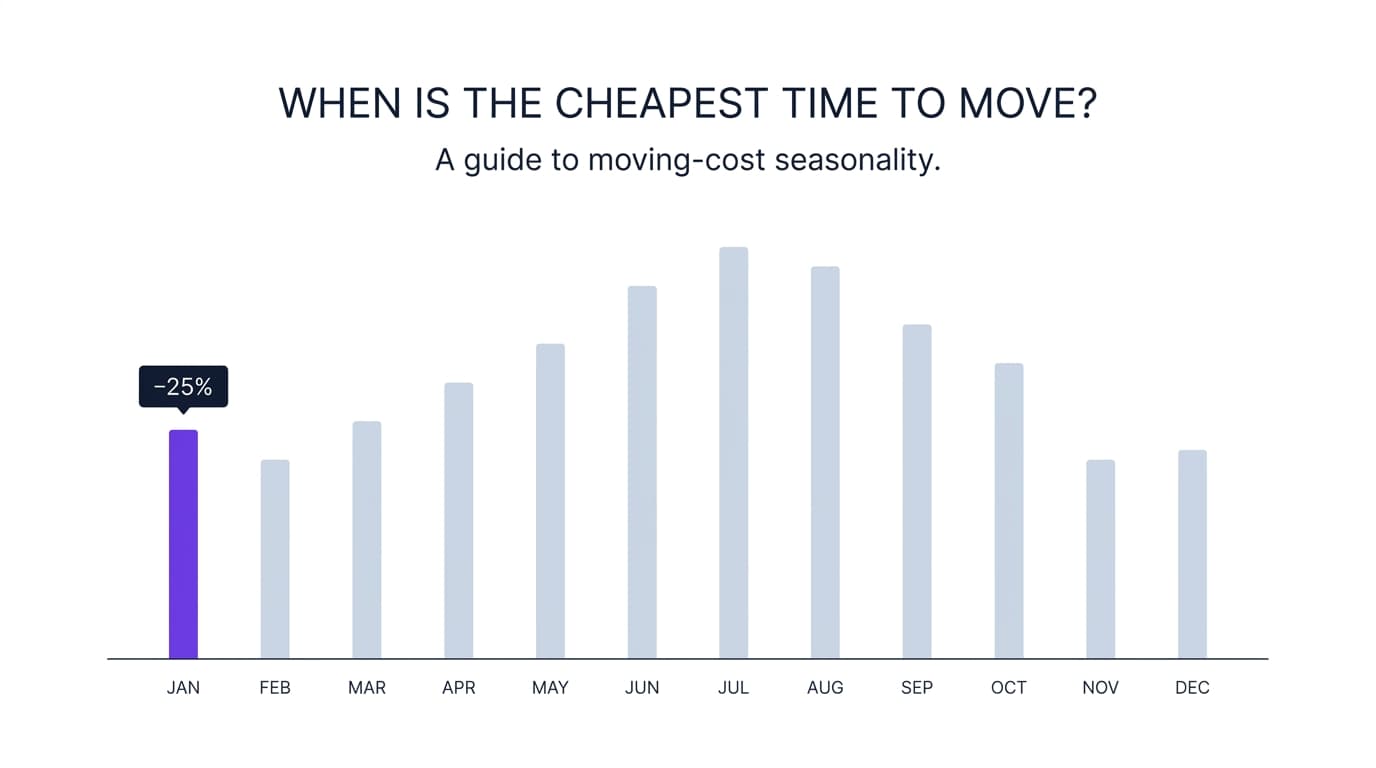
Moving is cheapest from late September through April, when 60–70% of US household moves are over and movers offer 15–25% discounts to fill schedules. The most expensive period is mid-May through August — specifically the last week of June through the first week of July, when demand peaks. Booking mid-week and mid-month within those off-peak windows can save another 10–15% on top of the seasonal discount.
Month by month
Movers price seasonally because demand collapses outside summer. A mid-July mover often quotes 20–25% above their January rate for the same load on the same route. The numbers we use in our calculator, calibrated against industry pricing surveys:
| Month | Multiplier | Tier |
|---|---|---|
| January | × 1.00 | Off-peak |
| February | × 1.00 | Off-peak |
| March | × 1.05 | Shoulder |
| April | × 1.10 | Shoulder |
| May | × 1.15 | Start of peak |
| June | × 1.22 | Peak |
| July | × 1.22 | Peak |
| August | × 1.18 | Tail of peak |
| September | × 1.10 | Shoulder |
| October | × 1.05 | Shoulder |
| November | × 1.00 | Off-peak |
| December | × 1.00 | Off-peak |
On a $5,000 base estimate, the difference between January (1.00) and July (1.22) is $1,100. That's real money — and it's the part of your move that's easiest to control.
Day of the month
About 60% of US residential leases turn over on the first of the month. That concentrates demand on the 28th–3rd window every month — movers are fully booked, surge pricing kicks in, and crews work overtime. Expect a 10–15% premium for first-of-month and last-of-month moves.
The cheapest weeks of any month are the 10th through the 20th. Movers have crews and trucks idle, and they'll discount or throw in add-on services to fill schedules.
Day of the week
Saturdays and Sundays are 8–12% more expensive than Tuesdays through Thursdays. Most office workers prefer to move on weekends, so weekends carry a demand premium. If you can move during the workweek, do — Tuesday and Wednesday are the consistently cheapest days, with Thursday a close third.
Weather and route effects
Off-peak winter savings are real, but build in a buffer for weather: northeast and midwest moves between mid-December and February can delay a day or two for storms. Most reputable movers will reschedule without penalty if a storm hits — confirm the policy in writing before you book.
Specific corridors also have local seasonal effects: Florida-bound moves spike in October and November (snowbird season), so winter isn't as discounted on those specific routes. Most other corridors follow the national pattern.
The booking strategy
- If you have flexibility, target a mid-week, mid-month, off-peak month move. Optimal: October 14, January 21, February 18 (Wed/Thu in the middle of an off-peak month).
- Get quotes for two adjacent dates — one in your target window, one as a fallback. Movers occasionally have last-minute openings at deeper discounts.
- Book 4–8 weeks out for off-peak, 8–12 weeks out for peak. Last-minute bookings always cost more.
- If your move date is non-negotiable and falls in peak season, bid out at least three written estimates. Variance widens in peak — you'll see 20–30% spread between movers, vs ~10% in off-peak.
In short
Move on a Tuesday in late January if you can. Move on a Saturday in late June if you have to. The difference, on a typical 2-bedroom long-distance move, is roughly $1,100–$1,500 in your pocket.